

Tech Talk
Minimizing Noise in Digital Audio Streaming Products
Dave Barber
Principle Hardware Engineer, HARMAN Luxury Audio

Introduction:
ARCAM recently released its latest range of streaming audio products, the ST25, SA35 and SA45. We look at how system noise can impact performance and how the range have been engineered for sonic excellence.
Why noise matters:
With the advancements of cutting-edge DAC technologies and high-resolution streaming platforms, today’s digital audio products offer extraordinary fidelity, promising to deliver the sample rates and bit-depths of the highest-resolution audio formats with unprecedented dynamic range. However, the dynamic range is only as good as the environment. A quiet DAC in a noisy system is like a concert pianist playing on a bridge over a busy motorway.
To truly realise the potential of these impressive DAC specifications, it's essential to understand the underlying noise within the system and how this influences the measured and perceived audio performance. Whether it’s a subtle veil over the soundstage or quantifiable degradation in dynamic range. System-level noise is the hidden assassin of audio fidelity.
In high-performance audio products, noise has long been an adversary in the analogue domain. Engineers are familiar with techniques of guarding op-amps inputs and shielding sensitive phono stages from external sources of electromagnetic interference (EMI) and radio frequency interference (RFI). These methods are well-understood and effective against noise sources like mains hum, RF interference, and electromagnetic fields from nearby equipment.
However, modern designs increasingly integrate powerful microprocessors and high-speed digital interfaces into an analogue landscape. What was once a mostly passive environment is now filled with high-speed switching, clock signals and internal EMI.
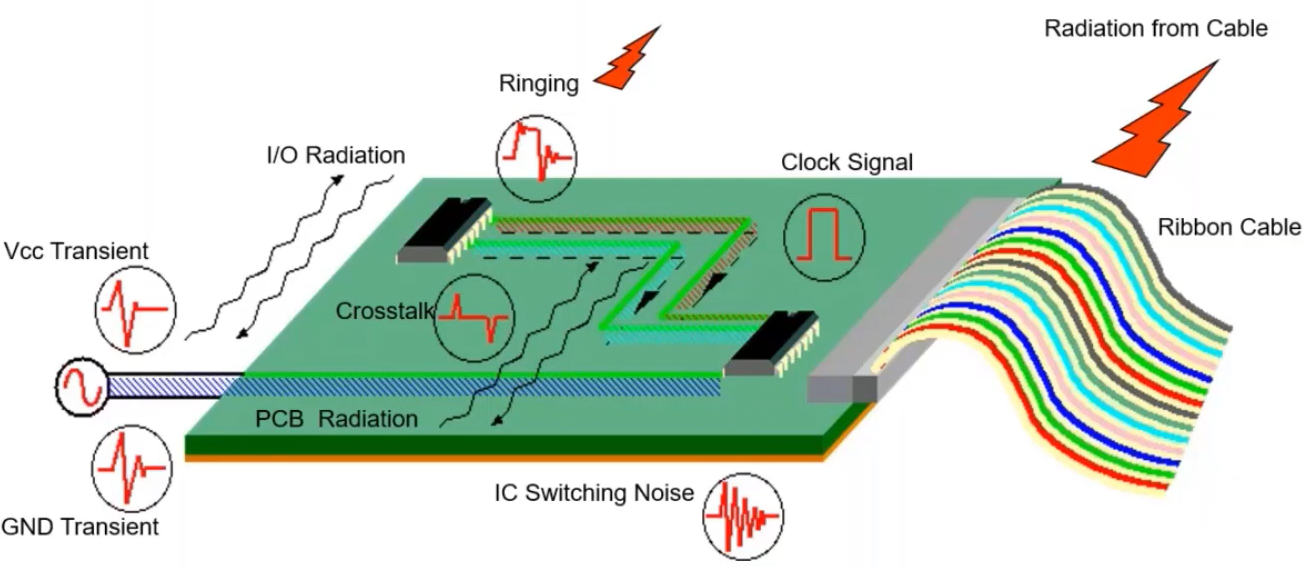
Switched mode regulators (SMPS): are often used for their efficiency, but their output inductors radiate noise. Their high frequency switching can introduce ripple and wideband noise. Wherever possible the use of linear regulators can drastically reduce noise in sensitive domains like DAC power supply rails and op-amp filter stages.
High speed interface switching noise: Fast signal rise/fall times from I²S and similar interfaces generate broadband spectral energy. Without proper impedance control, this energy can couple into adjacent traces or radiate from the board. Careful PCB design and routing, such as maintaining controlled impedance, minimising trace lengths, using solid ground planes and isolating high-speed signals from sensitive analogue circuitry helps confine this energy, reduce crosstalk, and suppresses unwanted noise that bleeds into analogue sections and generates audible artifacts.
Interconnects and Cable Radiation: High-speed traces and cables can radiate EMI, particularly at connector interfaces where impedance discontinuities or long stubs exist. This can corrupt other signals or even radiate through air into analogue or unshielded parts of the circuit. Typical ribbon cables are unshielded, so they offer little protection against radiated emissions or susceptibility to external noise, making them a potential conduit for interference between digital and analogue domains unless carefully routed, twisted, using balancing signalling, or replacing with shielded alternatives.
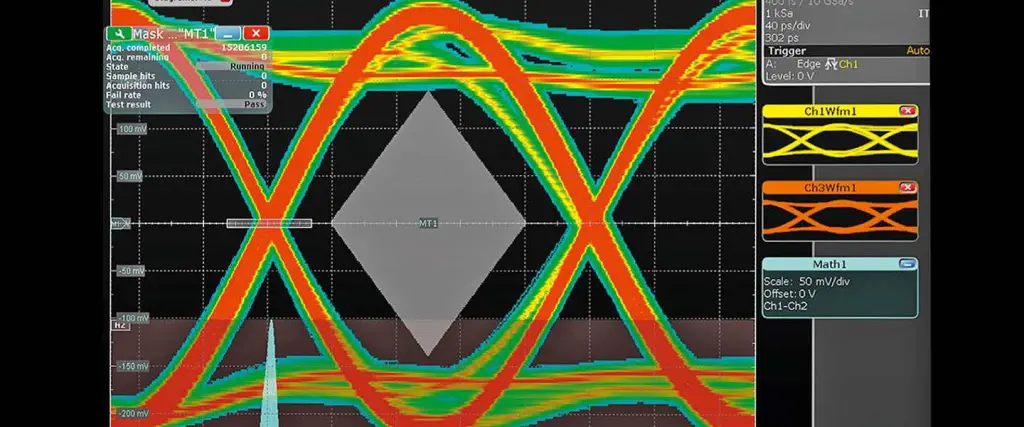
Power and Ground transients: Every switching event from a processor IC can cause current spikes through the Power distribution network (PDN). Poor decoupling or high loop inductance results in voltage dips or spikes than propagate through the board, impacting sensitive circuitry.
Effective power distribution is critical in mixed-signal audio systems, and capacitors play a central role in managing noise. Bulk capacitance, typically provided by larger electrolytic capacitors (see January Tech Talk), serves to stabilise the power supply over slower transients and load changes, acting as a reservoir of charge.
However, it’s local decoupling, the use of small specially selected capacitors, placed close to IC power pins that suppress high-frequency switching noise and transients caused by digital logic and clock edges. These capacitors provide a low-impedance path to ground for fast current spikes, preventing them from propagating through the PDN.
The PCB itself can be engineered to contribute capacitance. By placing the power and ground layers adjacent to each other in the PCB stack-up, designers create a distributed parallel-plate capacitor across the entire board. This provides a low-impedance path for high-frequency currents, helping to suppress switching noise and maintain signal integrity.
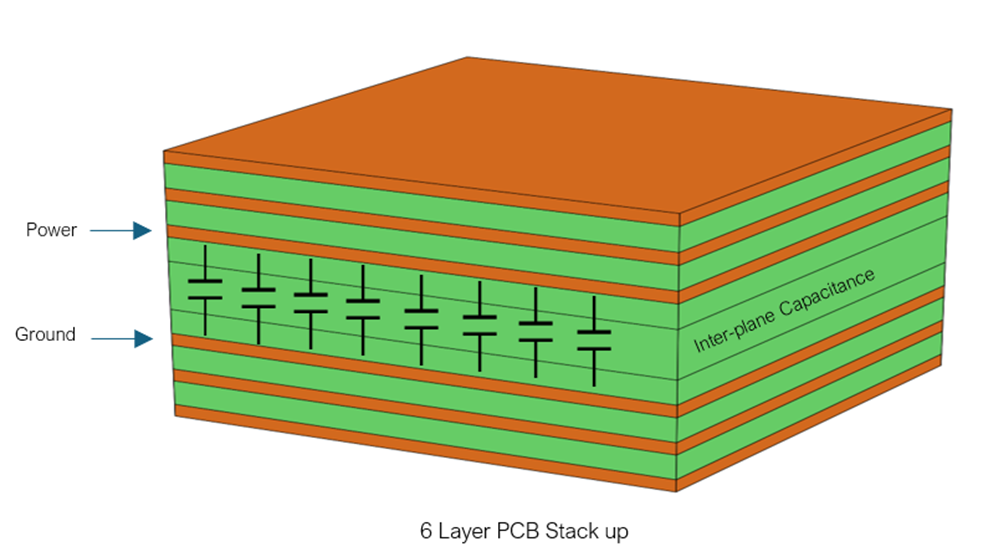
Together, capacitors, close-coupled planes and multiple ground layers form a robust framework for reducing EMI, managing transients, and supporting clean power delivery across the system.
Neglecting these layout and interface considerations can result in designs where digital noise infiltrates sensitive digital to analogue conversion circuitry, producing audible artifacts and degrading overall performance. Once these potential sources of interference are thoroughly addressed, the design focus can shift toward the DAC itself—where precision, linearity, and low noise are paramount.
The DAC: DAC’s from ESS with their Hyperstream IV topology can reproduce 32bit resolution audio, up to 768kHz sample rate with a dynamic range (DNR) of up to 124dB per channel, which can be paired with their ultra-low noise linear regulator to achieve vanishingly small distortion.
The dynamic range can be further improved by paralleling DAC outputs, which puts even tighter constraints on system noise.
When N number of outputs are summed the signal current increases by a factor of N. Noise adds randomly from each DAC output and is uncorrelated to the signal, so the noise increases as √N (Square root of the number of outputs).
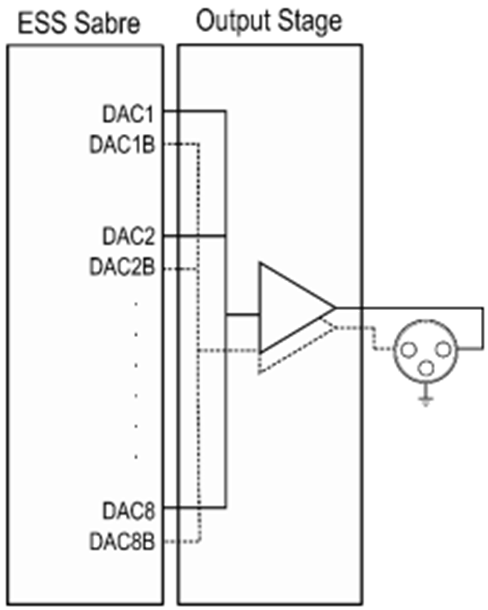
For two parallel outputs the signal doubles, so an increase of +6dB, with √2 or +3dB increase in noise, so a resulting improvement of 3dB.
To fully take advantage of the DAC, running its outputs in balanced configuration right to the amplifier further helps with noise rejection. This doubles the voltage swing of the signal without increasing distortion, improving the signal to noise ratio (SNR) before it reaches the amplifier.
This results in a quieter background, emphasizing the silence between notes and enhancing detail. This improved low level clarity helps with perception of depth and ambience and helps deliver a truly enjoyable and engaging musical experience.
How this relates to ARCAM products:
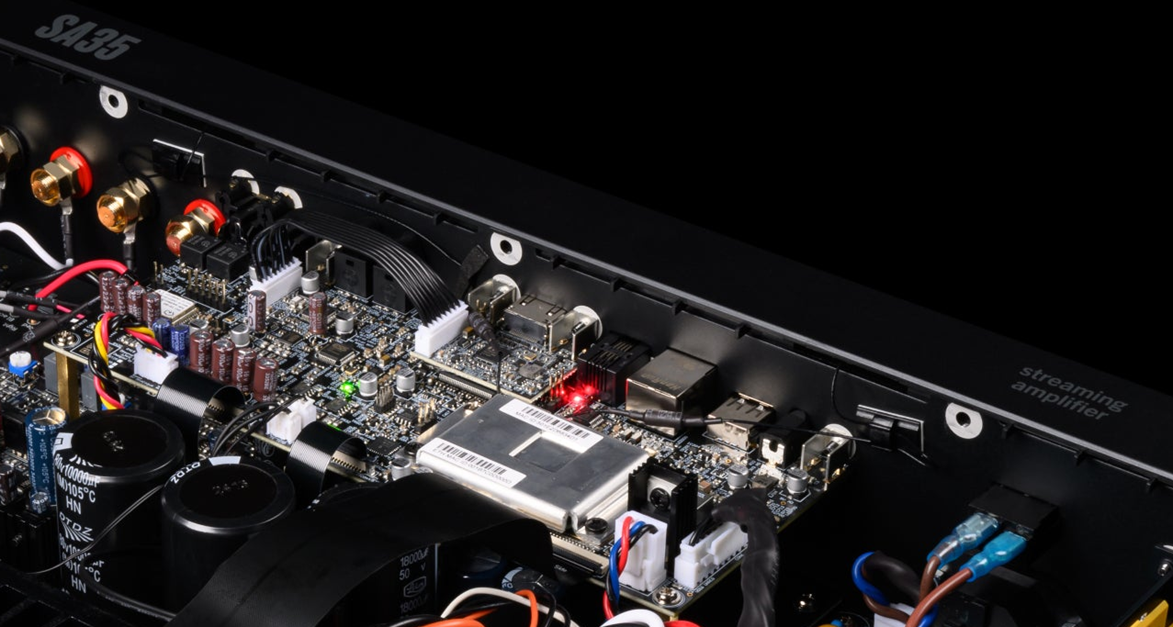
- All these noise mitigation and performance improvement techniques have been employed in the Streaming Audio board found in the new ARCAM Radia ST25, SA35 and SA45
- A custom in-house designed 6-Layer digital audio streaming platform PCB, Offering Ethernet and Wi-Fi Streaming, a wealth of SPDIF and HDMI digital inputs.
- Hosting a high-resolution streaming SOM (System on Module) and powerful Cortex M7 crossover MPU.
- 8 Channel ESS Hyperstream IV DAC with parallel balanced output
- 8 Channel Volume control with balance signal path from DAC to amp input/pre-amp outputs
- Custom multi-layer display FPC replaces traditional FFC single layer ribbon cables offering superior shielding and signal integrity
- Coupled with ARCAM’s 5th Generation Glass-G amplification technology - All meticulously designed for optimal audio performance