


What's New
The Guy with the Keys: A Conversation with David Glaubke on JBL's 80th
By Kat Wheeler
Director of Strategy, TIG Global PR

There's a moment David Glaubke comes back to when he talks about the JBL 80th anniversary. It wasn't the JBL 80th Playback Gallery exhibit in April. It wasn't the concurrent board meeting, or the media day, or the celebration party at the Roxy Theatre. It was quieter than all of that.
It was the day Mark Gander, the man who started at JBL in the mid-70s and spent decades as the living memory of the brand, threw a set of keys onto a desk. The tag on the keychain had two words: JBL History.
"He literally handed me over the stewardship of the brand history," David says. "And I looked down and thought — I have so much to learn."
Nine years later, David Glaubke, Director of Global Corporate Communications for HARMAN Professional Solutions and Luxury Audio Group, had just pulled off the most ambitious brand anniversary in JBL’s history. The Playback Gallery is a curated exhibit of heritage JBL products that travels to different stops around the world having appeared in Anaheim, Northridge, Amsterdam, and Vienna with future stops in Tokyo and New York.
I sat down with him to talk about what it took, what surprised him, and what he wants every person at HARMAN to understand about the brand they show up to work for every day.
Let's start at the beginning. Why the 80th? Why not wait for 85?
The timing was right. When you look at all of our brand touchpoints; portables, headphones, Pro, Luxury, the relationship with Toyota, the 80th felt like the right milestone to demonstrate how we show up together around one name. JBL.
We're also in a cultural moment where people are rediscovering physical media, re-exploring different eras of music, finding new connections to nostalgia. People are more aware than ever of how JBL is threaded through their entire day, from the time they wake up, to the car, to the gym, to the restaurant, to the concert hall at night. The 80th gave us a reason to say: here's how we got here. And for a lot of people, the reaction was, I didn't know you guys did all that. I didn't know you were the first.
That reaction is what this whole thing was built for.
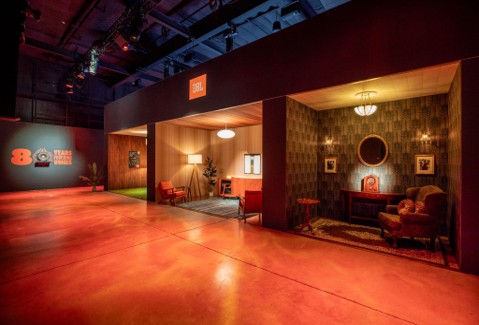
You designed the anniversary around a gallery experience, a space where people could see the entire JBL story in one place. How did you land on that?
The insight was pretty simple: nobody had ever put it all in one room before. These pieces have been in separate places for years and, frankly, disorganized and neglected.
With the Playback Gallery, I aimed to bring these restored products together and make logical connections from one product in history to another. How does a 1935 Lansing 15X field coil relate to a modern JBL ScreenArray cinema system? How does a JBL 4310 Studio Monitor from 1968 get to a 2026 JBL L100 80th edition? Is there a design philosophy shared between a 1979 JBL Cabaret portable PA and the modern JBL PartyBox? A Toyota Land Cruiser with a JBL audio system to a row of portable speakers to the Summit Series luxury home audio, all in one sightline. Depending on what you know about JBL or how you relate to it, the experience hit differently.
A man came up to me at The NAMM Show and pointed at the 4320 studio monitors and said, I recorded 100 albums off of those. Just stood there and said it like he was remembering every one of those sessions.
And then there were young people, people who had no context for the heritage products at all, walking up and wanting to touch the contours of the speakers, listen to the period music, take selfies next to them. They didn't know the history, yet asked tons of questions. But they felt something. That's JBL. That's always been JBL.
What's the piece of JBL history you think deserves more credit than it gets?
Two things. The D130 driver from the 1940s, that same driver that was part of the Woodstock sound system in 1969, was also sitting in someone's living room speaker at the exact same time. Jimi Hendrix and Janis Joplin playing through it on one side, and somebody at home just listening to records on the other. That driver lived everywhere, and most people don't know JBL’s pedigree from professional to home.
And then the Cabaret series from 1979. That was a genuine category creation moment. Before portable PA existed, bands were playing through whatever installed audio happened to be at the club, or through their amplifiers. Mark Gander, who oversaw the Cabaret project, had the vision to change that. What it did was democratize live sound. It gave garage bands and emerging artists access to pro-quality audio when they were just trying to find an audience. You dial all the way forward through the EON, and the PRX and that whole family traces back to the Cabaret. People don't connect those dots enough.
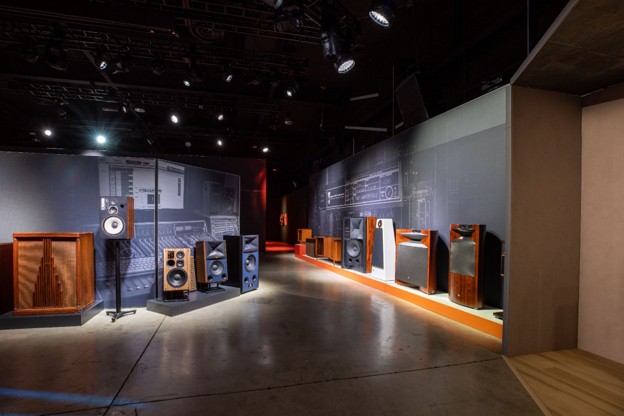
You had 80 years of products in one room. What's your personal favorite?
The Paragon. And I know that's a lot of people's answer, but there's a reason for it. The Paragon was the first stereophonic speaker designed for the home. But more than that, it was a piece of furniture, a piece of art, a piece of mid-century modern craftsmanship that just happened to also be the best-sounding speaker at the time. You could have put it in someone's living room with no music playing at all and it would have belonged there. The fact that music came through it was almost secondary to how beautiful it was.
JBL has always carried through that design philosophy -- the early Hartsfields, the K2s, the Summit Series, – you shouldn't have to choose between something that sounds extraordinary and something that looks like it belongs in your home. The Paragon is where that idea found its perfect form.
Tell us about the JBL History keys.
I came to HARMAN about ten years ago, and I don't come from audio manufacturing. My first career was in film and television production and development, then I worked across a lot of different industries running communications before landing at HARMAN. So, I had a lot to learn from those who devoted their entire careers to audio.
Mark Gander was my mentor in terms of understanding the importance of these brands, mainly JBL. He started at JBL in the mid-70s and he was the institutional memory of the place. I would shadow him on building tours and just not say a word. Just listen. And then ask questions afterward. He was also a bit of a pack rat, which turned out to be incredibly fortunate, because he kept so many of the important papers and documents from JBL's history stored under lock and key in metal file cabinets.
On his last day, he threw his set of keys onto my desk and said, now it's yours. I picked them up and the tag literally said JBL History. And I remember thinking; I have so much to learn. But I also think my industry newness worked in my favor. I approached it the way a curious outsider would, not someone who already knew all the answers. And I think that shaped my storytelling in ways that still hold today.
Talk to us about the Lansing family. That was clearly something you were looking forward to.
Yes. Hosting James B. Lansing’s family at the Playback Gallery was the last event before we took the display down, and it was the thing I had been looking forward to the entire week.
It started with a message from Iwan Arjanto, a JBL superfan and loudspeaker restorer based in Jakarta, Indonesia, who had been an incredible resource as I was building out the 80th. He mentioned that James B. Lansing had a granddaughter who might want to connect. And I thought, what would that even be like?
So, I emailed her, not expecting much, and we ended up talking for almost two hours. Lari Bain is the family spokesperson and keeper of the family history as it relates to JBL. I thought, when we close out the Northridge activation in April, the right way to end it is to bring the family to experience it. Instead of me telling the JBL story one more time, I wanted to hear them tell theirs.
In addition to the Gallery on the Experience Center Soundstage, I emptied all of Mark Gander's archive folders out onto the boardroom table and just let them explore. And the moment that stayed with me? The two surviving children, who were young when James passed in 1949, walking through those double doors into the Gallery for the first time. The first thing they saw was the vignette I had designed to imagine what the Lansing living room might have looked like in 1929. A Jackson Bell radio with a James Lansing loudspeaker inside.
You have to think about what that meant. JBL in its earliest days was a family business. James Lansing was an entrepreneur trying to build something, and families make real sacrifices when someone is chasing a dream. To be able to come back and see what that dream became, 80 years later, in a room full of the evidence of it, was something I will never forget watching. You could see it on their faces.
Think about being a Lansing child or grandchild standing in line at the grocery store, music playing, you look up and you see the L in the JBL logo. That is a source of pride that nothing can take away. Honoring the speakers without honoring the family that made them possible would have been a missed opportunity. I'm so glad we got it right.
It sounds like this took a village. Who deserves credit that might not always get it?
First of all, it wasn’t a village, it was an entire nation. For decades. Behind all that wonderful historical product and supporting creative were thousands of engineers, product managers, marketers, salespeople, and the customers and dealers who have given input to and purchased every single product that rolled out of our factories. They get credit.
And then there's the JBL subculture, and I say that with complete respect and admiration. There is a living, breathing community of people online, in forums, on YouTube, who have dedicated themselves to the knowledge and restoration of JBL products. Charles Murdoch and Iwan Argento, who we feature in the magazine, and so many others who chimed in with knowledge and context in real time that I simply could not have found anywhere else. They are the keepers of a lot of this history, and they care about it as much as anyone inside these walls.
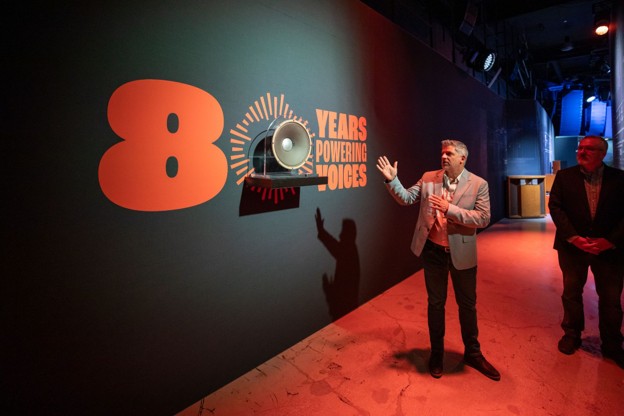
Remember that the 80th anniversary isn’t just the Playback Gallery. It is the JBL 80th Magazine, 80 Years Powering Voices video and so much more anniversary branding developed by the Communications and Marketing teams.
Someone in that community told me at one point that what we had built was great marketing. And honestly, it stopped me cold. I never really thought of it as marketing. I really thought of it as a platform to connect people who are passionate or new to the brand, with the stories that connects them to it.
Last question. What do you want the people reading this, your colleagues, to take from the 80th?
We are making history right now. Today. The Flip 7 that a teenager takes to the beach, the PartyBox On-the-Go at a party, the 708p studio monitor on the next No.1 hit album, the Summit Ama filling a living room with sound like the Paragon and the Hartsfield before. These are the heritage products that someone holds up at the 100th anniversary and says, I have so many memories associated with this.
Music does that. And JBL is the instrument that delivers it.