


Tech Talk
The D2 Compression Driver
By Erik Lundin
Principal Mechanical Engineer , HARMAN Luxury Audio

Introduction
I’m going to paraphrase myself from a future Tech Talk here and talk a little bit about acoustic impedance. All waves which travel through a medium experience a resistance to their wave motion. We call this resistance “impedance”, regardless of whether we’re discussing electrical waves, sound waves, or mechanical waves. In an electrodynamic loudspeaker, we are talking about all three. Electrical waves create mechanical waves, which create sound waves. One problem that always needs solving in this field is that when a wave encounters a sudden change in impedance, some of the energy of the wave is reflected back.
The diaphragm of a typical dome tweeter has a significantly higher output impedance than the load impedance of open air. The mismatch between these two leads to a lot of loss in these types of loudspeakers.
History
Albert Thuras and Edward Wente at Bell Labs invented one solution to this problem in the 1920s. Having the diaphragm radiate into a small chamber of air, constrained by the diaphragm on one side and a device they called the phasing plug on the other side, the air would compress much more as the diaphragm moved towards it. The air would still pass into the open air through multiple narrow channels, which expanded as they got further from the diaphragm. This loudspeaker is the compression driver, and because it has a much higher load impedance near the diaphragm, and allows the wave to gradually expand into the open air, it has significantly less losses.

Constraining it to an annular ring attached to the voice coil affords us the power and control of the large voice coil without the big floppy diaphragm. Obviously, these diaphragms have resonances as well, but the much lower mass and tighter constraints mean the resonances are constrained to a tighter band of frequencies, and those frequencies are much higher.

More is More
Dr. Alexander Voishvillo of HARMAN Professional is how we got to where we are today, with the invention of the D2 dual diaphragm compression driver. I mentioned previously how one of the advantages of the annular ring diaphragm over the big dome diaphragm is that it allows a large voice coil to move a relatively light diaphragm. Well, if one is good… Setting two annular polymer diaphragms up with their own voice coils and having them face each other lets them both radiate into a shared acoustic load. Instead of one diaphragm trying to compress the air in front of it, both diaphragms are pushing together, forcing the sound to exit through narrow channels into a shared chamber. This means that each diaphragm can either move much less to achieve the same volume, or move the same and achieve a higher volume. To achieve the same thing with a single diaphragm would mean having to use a much larger diaphragm. This would mean much higher mass, which is harder to control.
But there are benefits beyond just the diaphragm. Having two motors share a signal means that we can have all the joys of big sound without sacrificing the efficiency and control of small and light voice coils. In addition to being relatively light and easy to control for a given sound level, each voice coil only needs to dissipate half the electrical power input, which improves thermal compression. Higher maximum SPL and larger dynamic range, all at once.
The Details
The design is deceptively simple in concept, but as I’m fond of saying, everything is intuitive if you already know how it works. The details, of course, are much more complex. Hours of electrodynamic, mechanical, and acoustical coupled computer simulations, and untold more hours of prototyping and testing, got us the final design of these parts. Let’s look at the phasing plates of a D2815-16, the smallest D2 driver used in the JBL Summit series of speakers.

Here we see a cutaway of the entire driver, with all the parts labeled. Other than the central phasing plates, you can see how there are two separate motor structures with their own magnets and plates. Each drives a voice coil directly attached to the diaphragm along its ridge.

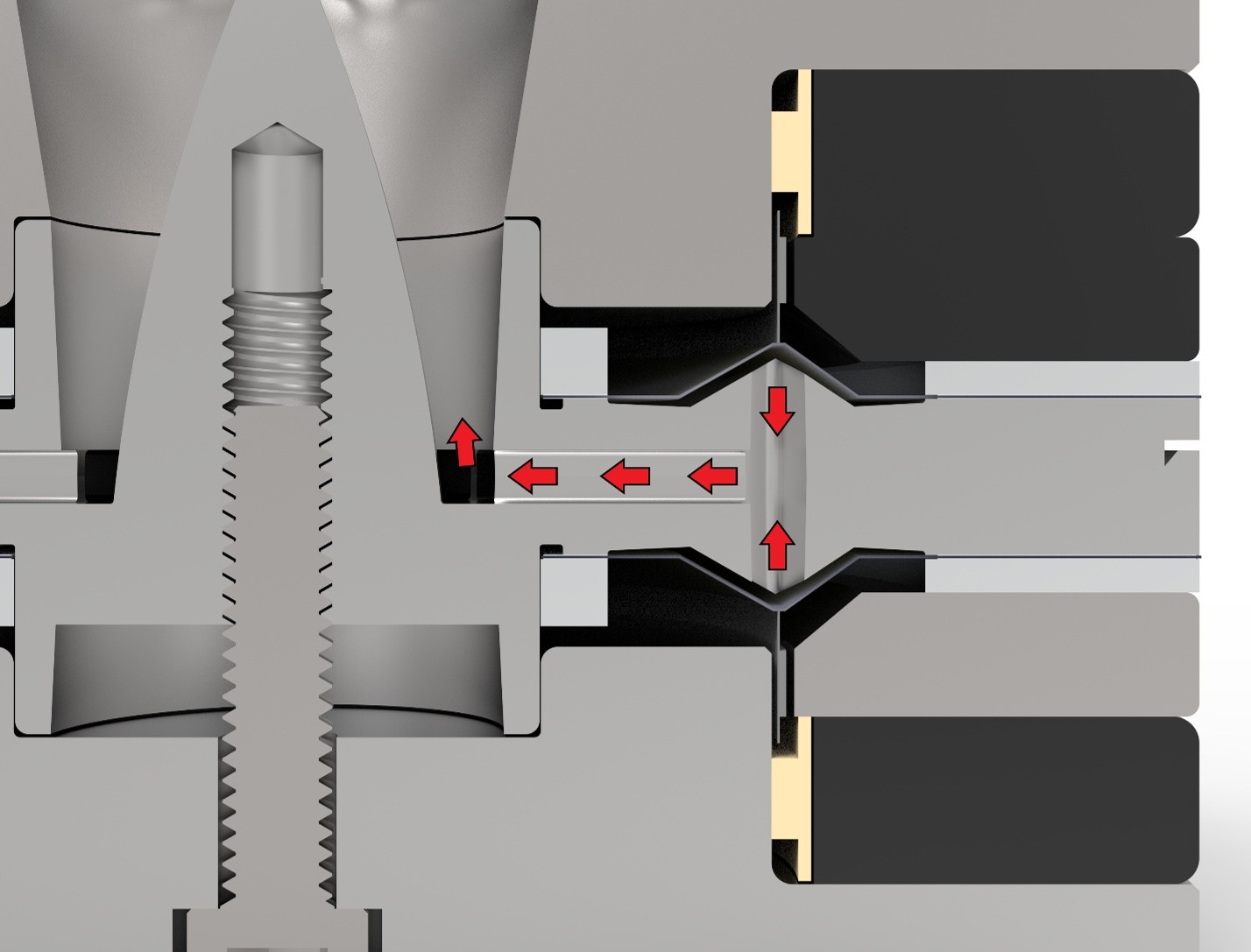
Here we see another cutaway, featuring the two opposing diaphragms firing into a narrow channel which expands outwards into the common summation chamber. One of the improvements on the original D2 drivers that was made for the JBL Summit series compression drivers involved Dr. Voishvillo fine tuning both the positioning of the axial channels along the diaphragm and the size of the radial channels as they lead inward.
From the summation chamber, the sound waves experience a fairly consistent expansion until they meet up with the waveguide, which further expands to meet the impedance of free air. You can enjoy the incredible clarity, precision, and sound level of JBL D2 compression drivers in more products than I can list here. The new D2815-16, D2820-16, and D2830-16 are featured in the JBL Summit series loudspeakers.