


Tech Talk
The Mark Levinson Approach to Class A – Class AB Amplifiers Part I


Intro: Classes of amplification
Amplifiers increase low-level audio signals to levels sufficient to drive loudspeakers. The “class” of an amplifier describes how its output devices conduct current over the signal cycle and how efficiently the amplifier operates. Among high-performance solid-state designs, the most prevalent topologies remain Class A and Class AB.
Class A
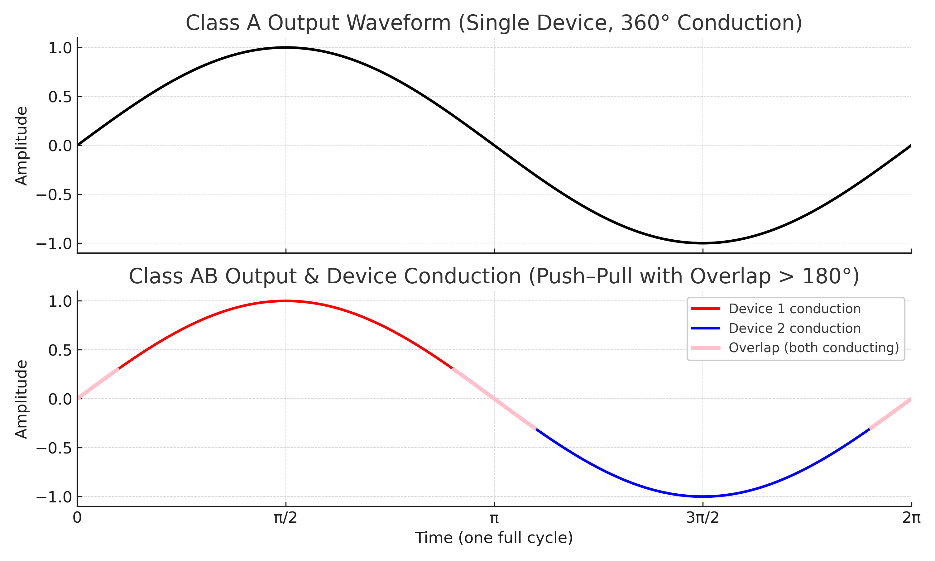
In Class A, the output devices conduct over the entire period of the waveform. With the devices never turning off, the signal avoids switching transitions and their associated nonlinearities. As a result, Class A operation is prized for its low distortion and linear transfer characteristics. The drawback, of course, is efficiency: conventional Class A stages are typically limited to ~25% theoretical efficiency, rising to ~50% only in transformer- or choke-coupled circuits. Significant idling current—commonly on the order of half the peak output current—must be always maintained, producing high dissipation (heat). Consequently, true Class A amplifiers require substantial power supplies, large heat sinks, and considerable thermal management, especially at higher output power levels.
The Mark Levinson ML-2 Amplifier
A landmark Class A amplifier example is the Mark Levinson ML-2 (1977), a 25-watt monaural pure Class A design created by engineer George Mayhew. The ML-2 demonstrated convincingly that a solid-state Class A amplifier could outperform vacuum-tube equipment in linearity, stability, and speaker control. It also set the design trend for later Mark Levinson reference amplifiers. With remarkable advances in loudspeaker technology, Mark Levinson products adjusted to the new requirements.

The Effects of Advances in Loudspeaker Technology
Modern loudspeakers generally require far more amplifier power than their vintage counterparts due to reduced sensitivity. Sensitivity is a measure of a speaker's ability to convert electrical power into sound pressure level (SPL). Several factors contribute:
- Compact enclosures with extended bass response: Contemporary designs aim for deep low-frequency performance from relatively small cabinets. Achieving this typically requires heavier, stiffer cones, lower-tuned alignments, and long-excursion drivers—all of which reduce efficiency.
- Greater emphasis on accuracy and neutrality: Modern loudspeakers prioritize controlled behavior: higher mechanical damping, flatter response, and reduced coloration. These choices frequently trade sensitivity for precision.
- More complex crossover networks: Multi-way designs with advanced crossovers, impedance compensation, and phase-alignment networks improve clarity but introduce additional losses.
- Modern materials and motor systems: Cones made from aluminum, Kevlar, carbon fiber, and other stiff composites, combined with large surrounds and high-force motors, improve linearity and excursion but generally have higher moving mass and demand more drive power.
- Changes in system expectations: Vintage speakers were often designed for use with amplifiers delivering only tens of watts. Today, 50–200 W per channel is common, as speaker designers prioritize acoustic performance over efficiency.
As a result, contemporary high-performance speakers routinely require robust amplification, and high-bias Class AB designs have become the practical standard for delivering both power and refinement.
Class B
In Class B, each half of the waveform is handled by a complementary device pair—one for the positive half, one for the negative. While this configuration offers good theoretical efficiency and zero quiescent dissipation, it suffers from crossover distortion due to imperfect handoff between devices. Class AB improves on this by applying moderate bias so both devices conduct slightly around the zero-crossing region, dramatically reducing switching artifacts while preserving much of Class B’s efficiency.
Mark Levinson adopted high-bias Class AB in later reference designs. The first of these was the No.20 monaural amplifier (mid-1980s), which operated in Class A up to a substantial portion of its output capability and incorporated fully regulated output-stage rails. Reviewers at the time praised its dimensionality, control, and low-frequency authority, placing it among the finest amplifiers available.
A more recent example is the limited-edition ML-50, created for the brand’s 50th anniversary. Restricted to one hundred pairs globally, the ML-50 draws direct inspiration from historic models including the ML-2 and its successors, the No.20, No.20.5, and No.20.6. Although operating as a high-bias Class AB amplifier, the ML-50 embodies many of the design philosophies that defined those earlier pure-Class-A and high-bias reference amplifiers.

Conclusion
While Class B and AB topologies offer clear advantages in efficiency and output power, they also present challenges—including crossover behavior, device matching, linearity at low signal levels, thermal stability and overall distortion reduction. Mark Levinson engineering has addressed these issues through sophisticated biasing schemes, robust power supplies, advanced output-stage topologies, and meticulous component selection. The specific techniques and solutions employed will be discussed in Part II of this Tech Talk.