

Tech Talk
The Midrange Is Where The Music Is
By George Short
Senior Principle Engineer, HARMAN Luxury Audio

Woofers and midranges look remarkably similar from the outside. However, upon closer inspection, the layers of design minutiae hidden behind the cone construct a very different world.
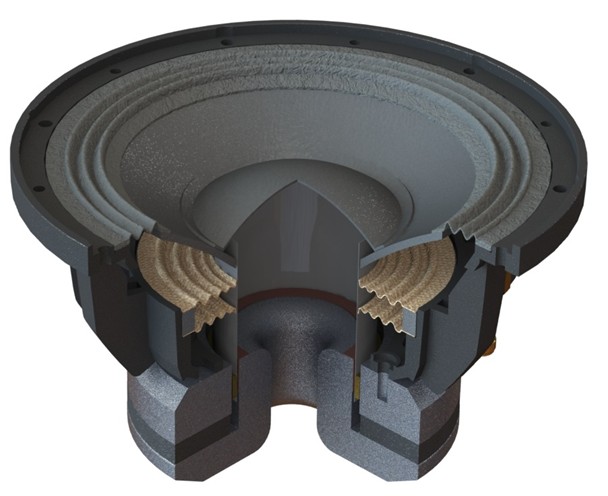
Summit JMW200SC-04 Midrange Exploded View

There are many common components and construction techniques shared between woofers and midranges, but also some important differences. With a woofer, we emphasize rugged durability through large cone motion in environments of significant stress. With a midrange, the emphasis is on reducing moving mass and concentrating motor strength.
A woofer is dedicated to durability under pressure. Moving air. Lots and lots of air.
A midrange is all about finesse.
A woofer is a football player. A midrange is a ballerina.
Common Elements
The basic design elements for both woofer and midrange transducers are actually the same:
(Hard, non-moving parts) Pole Piece – Faraday Sleeve - Magnet – Top Plate – Frame;
(Soft, moving parts) Voice Coil – Spider - Cone – Surround – Dust cap.
But within this list, every element can be optimized for its specific application to enhance our ballerina’s fluidity and grace.
Midrange-Specific Design Features:
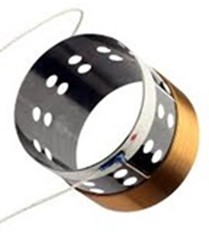
Underhung Four Layer Voice Coil
Copper-Clad Aluminum Voice Coil Wire
Vented Pole Piece
Thick Copper Faraday Sleeve
Neodymium Magnet
Dual Opposing Spiders
Cloth Accordion Surround
C4™-PMI Sandwich Cone
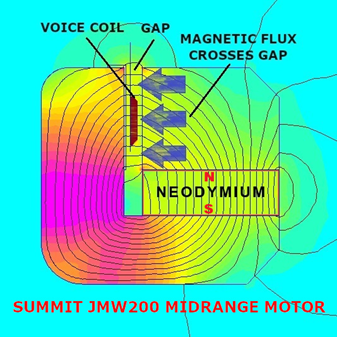
Four Layer Copper-Clad Aluminum Voice Coil and Underhung Motor Design:
The effort here was to concentrate as much magnetic field as possible along the path of the voice coil’s motion, and center the voice coil along the length of the field.
The “Force Factor”, and what it means:
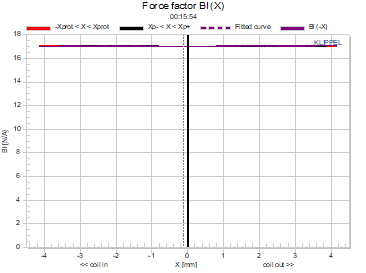
The motor Force Factor curve is a measurement of the sum of magnetic field strength (B) as it crosses the voice coil winding length (l), plotted against cone excursion (±x). In a perfect world, the Bl(x) curve would be a straight horizontal line, meaning the voice coil and therefore the cone experience constant motor force regardless of their motion. The “perfect world” simulation curve would look something like this: →→→
Only… the diagram at right is not a simulation, it is the actual measurement of the Summit 8-Inch midrange. This is the best Force Factor curve we have ever seen.
Copper Faraday Sleeve:
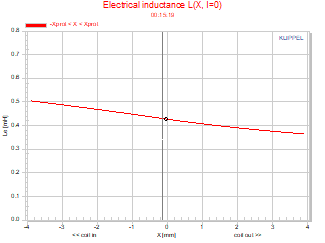
A ubiquitous feature in our mid-frequency transducers; a sleeve of formed copper hugging the pole piece. Manifested in the Summit JW200 Midrange, the copper is about twice as thick as one would find in a mid-woofer, to tame the higher locally generated fields of the four-layer voice coil. This stabilizes voice coil inductance and minimizes inductance variation over excursion, in this case to an amazing ±0.06mH, greatly simplifying crossover design. The copper also pulls heat out of the voice coil and into the motor, dissipating in the vented pole piece. The combination of a thick Faraday Sleeve and underhung motor reduces midrange distortion by an order of magnitude.
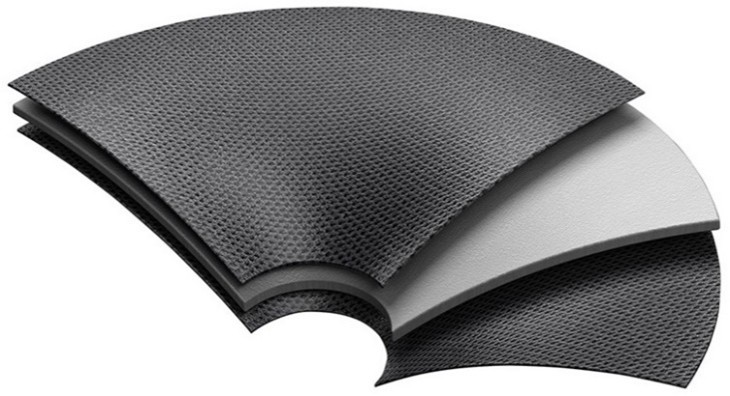
Woven Accordion Cloth Surround
For the surround, to make it as light as possible, we used a fine woven cloth that is pressed and treated under high pressure and heat. It is super flexible moving forward and back but incredibly stiff side-to-side, and so lightweight that it reacts instantly but doesn’t store any energy, hold vibration, or contribute a character of its own.
Ultra-Light PMI-C4™ Composite Sandwich Cone:
C4™ is Carbon Cellulose Composite Cone, a proprietary compound developed by JBL. It is a hard pressed, paper thin, rigid skin.
PMI (Polymethacrylimide) closed-cell foam was developed for the aeronautics industry, so light it almost floats in air.
We used the same PMI-C4™ sandwich cone technology in all Summits, but in this case we made the core thinner and lighter and bonded the sandwich with a compliant heat-activated adhesive.
Anechoic Chamber Measurements
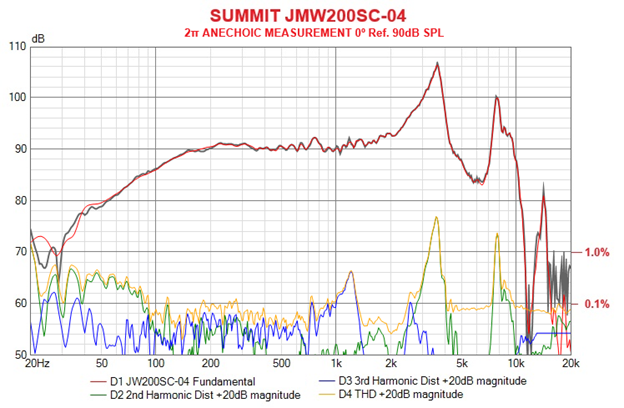
Below is the Total Harmonic Distortion measurement of the Summit JMW200SC-04 in our 2π Anechoic Chamber in Northridge. For most loudspeakers, 1% THD is felt to be the threshold of audibility, and distortion below 0.3% is considered phenomenally good. For its entire operating bandwidth, the Summit Midrange exhibits less than 0.3% and from 100Hz to 1kHz, a band of 3¼ octaves, it stays below 0.1%. Truly remarkable.
The Summit 8-Inch midrange - defining the state-of-the-art.
Addressments these fine details takes a tremendous amount of time and energy to perfect and implement. They all add incrementally to make the speaker better than was possible before. This midrange sets a new standard.
And it sounds as good as it looks.
Even with our ballerina, nothing succeeds like excess.