


Tech Talk
Efficiency as Part of the Sustainability Effort
Armando Martinez
Distinguished Engineer, HARMAN Luxury Audio

A few years ago, I had the opportunity to read an interesting book titled Cradle to Cradle. While not dark in a negative sense, it sheds light on many often-overlooked aspects of materials, recycling and sustainability.
In summary, product recycling is essential—but it’s not a cure-all for our sustainability challenges. We must focus not only on recycling but also on using less. Efficient use of resources is key, and efficiency is a cornerstone of any serious sustainability effort.
The good news is that we’re seeing more sustainable products emerge every day, across all industries. HARMAN is taking a proactive role by emphasizing sustainability and driving innovation across product lines, where MA receivers are not the exception.
A key differentiator in the MA’s AVR lineup is the use of high-efficiency power conversion stages. It makes perfect sense to adopt new technologies when they offer tangible benefits across multiple dimensions. Today’s users are more aware of energy usage, not just energy consumption itself, but all the associated impacts.
MA receivers utilize switching technologies that enable high efficiency, regardless of the specific topology. This translates into less heat, lower weight and reduced energy consumption, a more effective use of resources throughout the product life cycle.
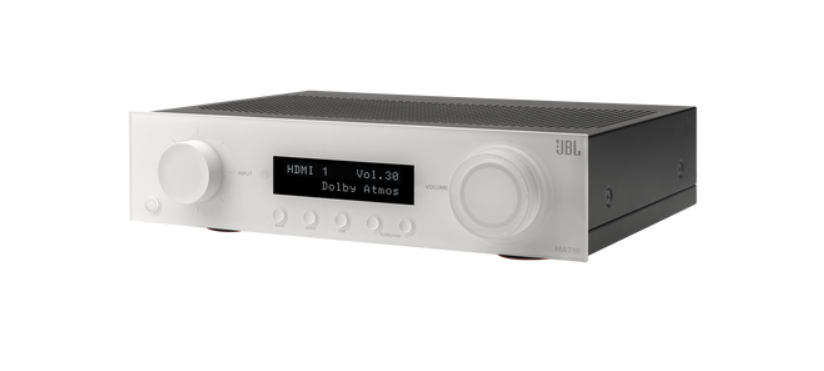
Take weight as an example. A conventional receiver with comparable output power using linear conversion technology can weigh at least 40 lbs. In contrast, the MA equivalent weighs about 13-lb, less than one-third. While a 27-lb difference may not seem like much, the true impact lies in the multiplying factor: shipping, handling, energy use over time, and production scale all amplify this benefit.
Energy use is not just about consumption at the user level. Every component in a system contributes to the overall energy footprint that goes from manufacturing and material sourcing to final assembly. More efficient systems typically require fewer components, meaning less material and shorter assembly time. New product designs are increasingly taking a holistic view, optimizing across the entire life cycle.
Advanced power management also allows for better control. One striking example is idle power consumption: a linear system may draw around 90W at idle, whereas a comparable high-efficiency system may use just 30W or even less. This ripple effect carries benefits from production through daily use.
As consumers and developers, we all have opportunities to make things better. Every contribution counts. Modern receivers are a great example of how better design and integration can lead to more sustainable solutions.
It’s a win-win situation that benefits both consumers and manufacturers.
For users who are still hesitant to adopt new technologies, that’s completely understandable. As we’ve discussed in previous tech talks, every system has its place. It’s like classic cars, driving one is a great experience, but not something most of us would choose for daily commuting. While pleasant, lower efficiency often comes with higher costs, especially for the environment.

Final thought: The multiplying effect is what truly matters. A single system might seem inconsequential, but when thousands are in use, the impact becomes significant.
The days of brute-force solutions are behind us. In the past, the answer to a problem was often simply to “add more power.” (“I’m giving her all she’s got!”) Today, we’re fortunate to have tools that allow us to work smarter. It's time to reduce our footprint by making wise decisions—so we can live long and prosper.